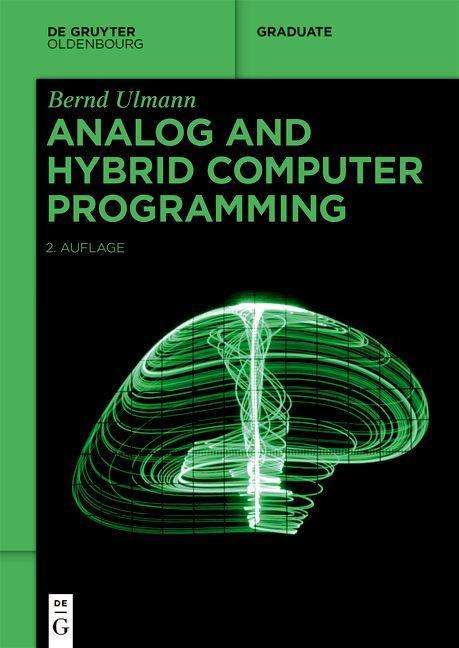

Bernd Ulmann: Analog and Hybrid Computer Programming, Flexibler Einband
Analog and Hybrid Computer Programming

- Verlag:
- de Gruyter Oldenbourg, 05/2023
- Einband:
- Flexibler Einband
- Sprache:
- Englisch
- ISBN-13:
- 9783110787597
- Artikelnummer:
- 11514489
- Sonstiges:
- 287 b/w ill., 7 b/w tbl.
- Nummer der Auflage:
- 23002
- Ausgabe:
- 2. Auflage
- Gewicht:
- 538 g
- Maße:
- 237 x 166 mm
- Stärke:
- 18 mm
- Erscheinungstermin:
- 22.5.2023
- Serie:
- De Gruyter Textbook
- Hinweis
-
Achtung: Artikel ist nicht in deutscher Sprache!
Klappentext
As classic digital computers are about to reach their physical and architectural boundaries, interest in unconventional approaches to computing, such as quantum and analog computers, is rapidly increasing. For a wide variety of practical applications, analog computers can outperform classic digital computers in terms of both raw computational speed and energy efficiency. This makes them ideally suited a co-processors to digital computers, thus forming hybrid computers.
This second edition of "Analog and Hybrid Computer Programming" provides a thorough introduction to the programming of analog and hybrid computers. It contains a wealth of practical examples, ranging from simple problems such as radioactive decay, harmonic oscillators, and chemical reaction kinetics to advanced topics which include the simulation of neurons, chaotic systems such as a double-pendulum simulation and many more. In addition to these examples, it contains a chapter on special functions which can be used as "subroutines" in an analog computer setup.
Biografie
Bernd Ulmann, Jahrgang 1970, studierte Mathematik an der Johannes-Gutenberg-Universität Mainz und diplomierte über Zahlentheorie/Kryptographie. Er arbeitete einige Jahre als Software-Berater und leitete Kurse und Schulungen zu den Themen Programmierung, Betriebssysteme, Algorithmen und Datenstrukturen. Seit 1999 hält er Vorlesungen an der hessischen Verwaltungs- und Wirtschaftsakademie (VWA) und der Berufsakademie (BA). Seine Leidenschaft sind Analogrechner. 2009 promovierte er zu diesem Thema an der Universität Hamburg. Er hat seit Kurzem die Professur für Wirtschaftsinformatik der Fachhochschule für Oekonomie und Management in Frankfurt inne.