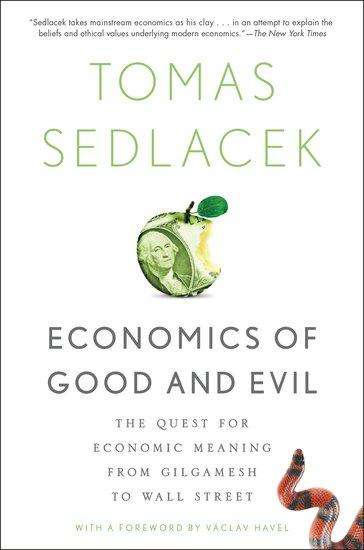

Tomas Sedlacek: Economics of Good and Evil, Kartoniert / Broschiert
Economics of Good and Evil
- The Quest for Economic Meaning from Gilgamesh to Wall Street

(soweit verfügbar beim Lieferanten)
- Verlag:
- OUP US, 10/2013
- Einband:
- Kartoniert / Broschiert, Paperback
- Sprache:
- Englisch
- ISBN-13:
- 9780199322183
- Artikelnummer:
- 2418114
- Umfang:
- 374 Seiten
- Copyright-Jahr:
- 2013
- Gewicht:
- 539 g
- Maße:
- 233 x 156 mm
- Stärke:
- 25 mm
- Erscheinungstermin:
- 3.10.2013
- Hinweis
-
Achtung: Artikel ist nicht in deutscher Sprache!
Beschreibung
Tomas Sedlacek has shaken the study of economics as few ever have. Named one of the "Young Guns" and one of the "five hot minds in economics" by the Yale Economic Review, he serves on the National Economic Council in Prague, where his provocative writing has achieved bestseller status. How has he done it? By arguing a simple, almost heretical proposition: economics is ultimately about good and evil.
In The Economics of Good and Evil, Sedlacek radically rethinks his field, challenging our assumptions about the world. Economics is touted as a science, a value-free mathematical inquiry, he writes, but it's actually a cultural phenomenon, a product of our civilization. It began within philosophy Adam Smith himself not only wrote The Wealth of Nations, but also The Theory of Moral Sentiments and economics, as Sedlacek shows, is woven out of history, myth, religion, and ethics. "Even
the most sophisticated mathematical model," Sedlacek writes, "is, de facto, a story, a parable, our effort to (rationally) grasp the world around us." Economics not only describes the world, but establishes normative standards, identifying ideal conditions. Science, he claims, is a system of beliefs to which
we are committed. To grasp the beliefs underlying economics, he breaks out of the field's confines with a tour de force exploration of economic thinking, broadly defined, over the millennia. He ranges from the epic of Gilgamesh and the Old Testament to the emergence of Christianity, from Descartes and Adam Smith to the consumerism in Fight Club. Throughout, he asks searching meta-economic questions: What is the meaning and the point of economics? Can we do ethically all that we can do
technically? Does it pay to be good?
Placing the wisdom of philosophers and poets over strict mathematical models of human behavior, Sedlacek's groundbreaking work promises to change the way we calculate economic value.
Klappentext
In The Economics of Good and Evil, Sedlacek challenges widely-held beliefs about economics and culture by tracing the study and themes of economics throughout history.
Biografie (Tomas Sedlacek)
Tomá Sedlácek lehrt an der Prager Karls-Universität, ist Chefökonom der größten tschechischen Bank und Mitglied des Nationalen Wirtschaftsrats in Prag. Während der Amtszeit des tschechischen Präsidenten Václav Havel arbeitete er als dessen Berater. Er ist ein gefragter Radio- und Fernsehkommentator.Biografie (Vaclav Havel)
Václav Havel wurde am 5. Oktober 1936 in Prag geboren. In den sechziger Jahren machte er sich mit Stücken, in denen er Elemente des absurden Theaters Ionescos aufnahm, als Theaterschriftsteller einen Namen. 1968 war Havel als Vorsitzender des Clubs der unabhängigen Schriftsteller in der Reformbewegung des Prager Frühlings aktiv und übte scharfe Kritik an der Invasion der Warschauer-Pakt-Truppen in der Tschechoslowakei zur Niederschlagung des Prager Frühlings. Daraufhin erhielt Václav Havel Publikations- und Aufführungsverbot und schlug sich als Hilfsarbeiter in einer Brauerei durch, setzte sich aber trotz vielfältiger Schikanen weiterhin für die Wahrung der Menschenrechte ein. Václav Havel war 1977 Mitbegründer der Bürgerrechtsbewegung Charta 77, und in den folgenden zehn Jahren wurde er mehrfach verhaftet. 1989 stand er an der Spitze des oppositionellen Bürgerforums, das einer der Initiatoren der Massenproteste der Bevölkerung war, die schließlich zum Sturz des kommunistischen Regimes führten. Im Dezember 1989 wurde Václav Havel zum Präsidenten der Tschechoslowakei gewählt. Mit der Teilung der Tschechoslowakei in zwei getrennte Republiken, die Tschechische Republik und die Slowakei, legte Havel am 2. Juli 1992 sein Amt als Präsident der Tschechoslowakei nieder. Im Januar 1993 wurde Václav Havel zum Präsidenten der neuen Tschechischen Republik gewählt. Havel setzte sich für eine Mitgliedschaft der Tschechischen Republik sowie anderer ehemaliger Ostblockstaaten in der NATO ein.1989 erhielt Václav Havel den Friedenspreis des Deutschen Buchhandels, und 1991 wurde er für seinen Einsatz für die Demokratie und den Frieden unter den Völkern mit dem Internationalen Karlspreis der Stadt Aachen ausgezeichnet. Am 2. Februar 2003 endete seine zweite Amtszeit.§2010 wurde Václav Havel mit dem Kafka-Preis für sein Werk ausgezeichnet.