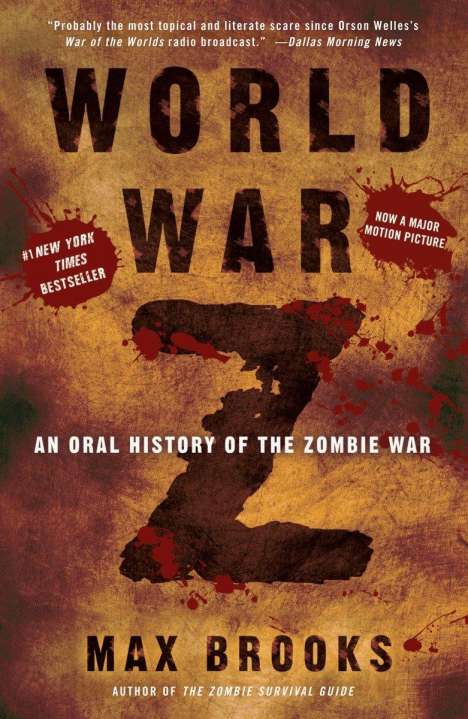

Max Brooks: World War Z, Kartoniert / Broschiert
World War Z
- An Oral History of the Zombie War

- Verlag:
- Random House LLC US, 10/2007
- Einband:
- Kartoniert / Broschiert, ,
- Sprache:
- Englisch
- ISBN-13:
- 9780307346612
- Artikelnummer:
- 6250209
- Umfang:
- 368 Seiten
- Copyright-Jahr:
- 2007
- Gewicht:
- 288 g
- Maße:
- 203 x 133 mm
- Stärke:
- 32 mm
- Erscheinungstermin:
- 1.10.2007
- Hinweis
-
Achtung: Artikel ist nicht in deutscher Sprache!
Weitere Ausgaben von World War Z |
Preis |
|---|
Beschreibung
NOW A MAJOR MOTION PICTURE
We survived the zombie apocalypse, but how many of us are still haunted by that terrible time? We have (temporarily?) defeated the living dead, but at what cost? Told in the haunting and riveting voices of the men and women who witnessed the horror firsthand, World War Z , now a No. 1 New York Times bestseller, is the only record of the plague years.
Rezension
No. 1 NEW YORK TIMES BESTSELLER
USA TODAY BESTSELLER
WALL STREET JOURNAL BESTSELLER
"An 'oral history' of the global war the evil brain-chewers came within a hair of winning. Zombies are among us - turn on your television if you don't believe it. But, Brooks reassures us, even today, human fighters are hunting down the leftovers, and we're winning. [His] iron-jaw narrative is studded with practical advice on what to do when the zombies come, as they surely will. A literate, ironic, strangely tasty treat."
- Kirkus Reviews (starred review)
"Max Brooks has charted the folly of a disaster response based solely on advanced technologies and brute force in this step-by-step guide to what happened in the Zombie War. He details with extraordinary insight how in the face of institutional missteps and greed, people in unexpected ways achieve unique, creative, and effective strategies to survive and fight back. Brooks's account of the path to recovery and reconstruction after the war is fascinating, too. World War Z provides us with a starting point, at least, a basic blueprint from which to build a popular understanding of how, when, and why such a disaster came to be, and how small groups and individuals survived."
- Jeb Weisman, Ph. D.,Director of Strategic Technologies, National Center for Disaster Preparedness
"Possesses more creativity and zip than entire crates of other new fiction titles. Think Mad Max meets The Hot Zone . . . It's Apocalypse Now , pandemic-style. Creepy but fascinating."
- USA TODAY
"Prepare to be entranced by this addictively readable oral history of the great war between humans and zombies. . . . Will grab you as tightly as a dead man's fist. A."
- Entertainment Weekly, EW Pick
"Probably the most topical and literate scare since Orson Welles' War of the Worlds radio broadcast. . . . This is action-packed social-political satire with a global view."
- Dallas Morning News
"Brooks [is] America's most prominent maven on the living dead. . . . Chilling. . . . It is gripping reading and a scathing indictment of weak responses to crises real and over-hyped."
- Hartford Courant
"A sober, frequently horrifying and even moving account. . . . Brooks has delivered a full-blown horror novel, laced with sharp social and political observations and loads of macabre, gruesome imagery. . . . The real horror of World War Z comes from the all-too-plausible responses of human beings and governments to the menace."
- Fangoria
"A horror fan's version of Studs Terkel's The Good War . . . . Like George Romero's Dead trilogy, World War Z is another milestone in the zombie mythology."
- Booklist
"Brooks commits to detail in a way that makes his nightmare world creepily plausible. . . . Far more affecting than anything involving zombies really has any right to be. . . . The book . . . opens in blood and guts, turns the world into an oversized version of hell, then ends with and affirmation of humanity's ability to survive the worst the world has to offer. It feels like the right book for the right times, and that's the eeriest detail of all."
- A. V. Club, The Onion
"The best science fiction has traditionally been steeped in social commentary. World War Z continues that legacy. . . . We haven't been this excited about a book without pictures since–well, since ever."
- Metro
"Each story locks together perfectly to create a wonderful, giddy suspense. Brooks also has the political savvy to take advantage of any paranoia a modern reader might feel. . . . The perfect book for all us zombie junkies."
- Paste
"This infectious and compelling book will have nervous readers watching the streets for zombies. Recommended."
- Library Journal
Klappentext
#1 NEW YORK TIMES BESTSELLER • "Prepare to be entranced by this addictively readable oral history of the great war between humans and zombies."-Entertainment Weekly
We survived the zombie apocalypse, but how many of us are still haunted by that terrible time? We have (temporarily?) defeated the living dead, but at what cost? Told in the haunting and riveting voices of the men and women who witnessed the horror firsthand, World War Z is the only record of the pandemic.
The Zombie War came unthinkably close to eradicating humanity. Max Brooks, driven by the urgency of preserving the acid-etched first-hand experiences of the survivors, traveled across the United States of America and throughout the world, from decimated cities that once teemed with upwards of thirty million souls to the most remote and inhospitable areas of the planet. He recorded the testimony of men, women, and sometimes children who came face-to-face with the living, or at least the undead, hell of that dreadful time. World War Z is the result. Never before have we had access to a document that so powerfully conveys the depth of fear and horror, and also the ineradicable spirit of resistance, that gripped human society through the plague years.
THE INSPIRATION FOR THE MAJOR MOTION PICTURE
"Will spook you for real."-The New York Times Book Review
"Possesses more creativity and zip than entire crates of other new fiction titles. Think Mad Max meets The Hot Zone. . . . It's Apocalypse Now, pandemic-style. Creepy but fascinating."-USA Today
"Will grab you as tightly as a dead man's fist. A."-Entertainment Weekly, EW Pick
"Probably the most topical and literate scare since Orson Welles's War of the Worlds radio broadcast . . . This is action-packed social-political satire with a global view."-Dallas Morning News
Auszüge aus dem Buch
WARNINGS GREATER CHONGQING, THE UNITED FEDERATION OF CHINA [At its prewar height, this region boasted a population of over thirty-five million people. Now, there are barely fifty thousand. Reconstruction funds have been slow to arrive in this part of the country, the government choosing to concentrate on the more densely populated coast. There is no central power grid, no running water besides the Yangtze River. But the streets are clear of rubble and the local "security council" has prevented any postwar outbreaks. The chairman of that council is Kwang Jingshu, a medical doctor who, despite his advanced age and wartime injuries, still manages to make house calls to all his patients.] The first outbreak I saw was in a remote village that officially had no name. The residents called it "New Dachang," but this was more out of nostalgia than anything else. Their former home, "Old Dachang," had stood since the period of the Three Kingdoms, with farms and houses and even trees said to be centuries old. When the Three Gorges Dam was completed, and reservoir waters began to rise, much of Dachang had been disassembled, brick by brick, then rebuilt on higher ground. This New Dachang, however, was not a town anymore, but a "national historic museum." It must have been a heartbreaking irony for those poor peasants, to see their town saved but then only being able to visit it as a tourist. Maybe that is why some of them chose to name their newly constructed hamlet "New Dachang" to preserve some connection to their heritage, even if it was only in name. I personally didn't know that this other New Dachang existed, so you can imagine how confused I was when the call came in. The hospital was quiet; it had been a slow night, even for the increasing number of drunk-driving accidents. Motorcycles were becoming very popular. We used to say that your Harley-Davidsons killed more young Chinese than all the GIs in the Korean War. That's why I was so grateful for a quiet shift. I was tired, my back and feet ached. I was on my way out to smoke a cigarette and watch the dawn when I heard my name being paged. The receptionist that night was new and couldn't quite understand the dialect. There had been an accident, or an illness. It was an emergency, that part was obvious, and could we please send help at once. What could I say? The younger doctors, the kids who think medicine is just a way to pad their bank accounts, they certainly weren't going to go help some "nongmin" just for the sake of helping. I guess I'm still an old revolutionary at heart. "Our duty is to hold ourselves responsible to the people." Those words still mean something to me . . . and I tried to remember that as my Deer bounced and banged over dirt roads the government had promised but never quite gotten around to paving. I had a devil of a time finding the place. Officially, it didn't exist and therefore wasn't on any map. I became lost several times and had to ask directions from locals who kept thinking I meant the museum town. I was in an impatient mood by the time I reached the small collection of hilltop homes. I remember thinking, This had better be damned serious. Once I saw their faces, I regretted my wish. There were seven of them, all on cots, all barely conscious. The villagers had moved them into their new communal meeting hall. The walls and floor were bare cement. The air was cold and damp. Of course they're sick, I thought. I asked the villagers who had been taking care of these people. They said no one, it wasn't "safe." I noticed that the door had been locked from the outside. The villagers were clearly terrified. They cringed and whispered; some kept their distance and prayed. Their behavior made me angry, not at them, you understand, not as individuals, but wha
Biografie
Max Brooks, geb. 1972, ist der Sohn von Mel Brooks und Anne Bancroft. Er lebt als erfolgreicher Comedy Autor in New York City, ist nach eigenem Bekunden aber stets bereit, von heute auf morgen an einen abgelegenen Ort zu ziehen, der leichter zu verteidigen ist.