
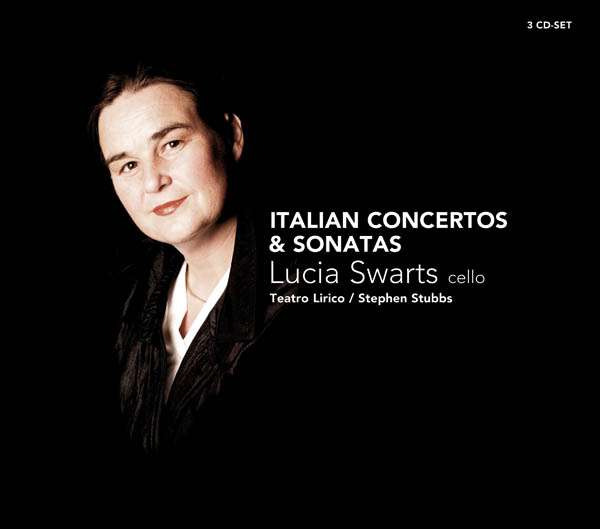
Lucia Swarts - Italian Cello Concertos & Sonatas
Lucia Swarts - Italian Cello Concertos & Sonatas
Mit Werken von:
Giovanni Benedetto Platti (1697-1763)
, Nicola Antonio Porpora (1686-1768)
, Giuseppe Maria Jacchini (1663-1727)
, Leonardo Leo (1694-1744)
, Antonio Vivaldi (1678-1741)
, Luigi Boccherini (1743-1805)
3
CDs
CD (Compact Disc)
Herkömmliche CD, die mit allen CD-Playern und Computerlaufwerken, aber auch mit den meisten SACD- oder Multiplayern abspielbar ist.

-
Platti: Cellokonzerte C-Dur & c-moll
+Porpora: Cellokokonzert a-moll
+Jacchini: Cellokonzert op. 4 Nr. 9
+Leo: Cellokonzert d-moll
+Vivaldi: Konzert RV 531 für 2 Celli & Streicher; Cellosonaten RV 40, 41, 43, 45-47
+Boccherini: Sonaten für Cello & Bc G. 5, 6, 10, 13
- Künstler: Lucia Swarts, Richte van der Meer, Siebe Henstra, Teatro Lirico, Stephen Stubbs
- Label: Challenge, DDD, 1996-1999
- Bestellnummer: 4931493
- Erscheinungstermin: 10.5.2011
Produktinfo:
Diese Wiederveröffentlichung vereint drei wundervolle Einspielungen, die sich ganz dem italienischen Cellorepertoire widmen. Lucia Swarts gehört zu den renommiertesten Cellistinnen ihrer Generation.
Product-Information:
At the beginning of the seventeenth century the violin set out on its march of conquest as a solo instrument. Before then the violin was not thought highly of, but the French theorist Martin Mersenne (1588-1648) called it the king of instruments and praised it for its versatility. It lasted almost a half century before the expressive potential of the (violon)cello, the lyrical tenor and sonorous bass of the same family of instruments, was discovered.
Not without justification, the significance of Antonio Vivaldi (1678-1741) for the
Concerto has been compared to that of Haydn for the symphony.
Also under the influence of virtuoso violin music, which was developing fast, composers of the 17th century were inspired to write solo music for this ›bass violin‹, too. In turn, this required ›adjustments‹ to the instrument, which was unsuit-able for virtuoso solo play, we see therefore that violin builders in the second half of the 17th century started experimenting. In almost all cases this concerned a scaling down of the instruments. Their tuning also varied. These variants were known by varying names. In 1665 we find the term of ›violoncello‹ for the first time (with G. C. Arresti).
Of Antonio Vivaldi, the most influential, original and prolific composer of instrumental music for cello of the first half of the 18th century, we know nine cello sonatas.
Then came Luigi Boccherini, a cellist but above all a visionary composer. He introduced the thumb position and thereby established a new historical record with b’‹ flat as the highest note. Luigi Boccherini (19 February 1743 - 28 May 1805) was already a celebrity during his lifetime. This contemporary of Mozart made his début as a cellist at the age of 13 in his native town of Lucca and soon became a respected virtuoso in local musical circles.
Boccherini was an extraordinarily fertile composer, especially of chamber music. He wrote 32 sonatas for cello. In this CD box we can listen to four of them. Vivaldi wrote some very special pieces, but as far as Lucia Swarts is concerned Boccherini leaves him far behind. That cantilena, that Italian singing style, Boccherini could bring it out with greater prominence than any other composer. In the past the cello functioned as a bass instrument. With Vivaldi it acquired something of a tenor voice, but in the end it was Boccherini who knew how to use it as a perfect alto instrument. According to Lucia Swarts to cellists Boccherini is supremely important.
Also in this CD box are Italian 18th century cello pieces by Platti, Jacchini, Leo and Porpora.
Rezensionen
Klassik heute 8/1999: »So kommt es, daß der eigentliche Star dieser CD nicht die Solistin, sondern das Teatro Lirico ist, das mit seinem sehr farbigen, resonanzreichen und von sprechenden Gesten geprägten Spiel rundum überzeugt.«Klassik heute 5/98: »Bei soviel Differenzierung, Neugier und Sinn fürs Ornament treiben Vivaldis kurze Stücke eine Blüte nach der anderen. Hocherfreulich auch der präzise, aber nicht angenagelte Aufnahmeklang.«
FonoForum 8/2000: »Frisch-kommunikatives Ensemble-Spiel und eine klanglich sehr reizvolle Besetzung. Der lyrische Charakter der Musik wird auf eine Weise freigelegt, dass in den Stücken ein selten so gehörtes, feingliedriges Innenleben erwacht. Technische Bravour ist dazu notwendige Selbstverständlichkeit.«
- Tracklisting
- Mitwirkende
Disk 1 von 3 (CD)
- 1 Lucia Swarts: Concerto For Violoncello And Strings In C Major
- 2 Lucia Swarts: Concerto For Violoncello And Strings In C Major
- 3 Lucia Swarts: Concerto For Violoncello And Strings In C Major
- 4 Lucia Swarts: Concerto For Violoncello And Strings In A Minor
- 5 Lucia Swarts: Concerto For Violoncello And Strings In A Minor
- 6 Lucia Swarts: Concerto For Violoncello And Strings In A Minor
- 7 Lucia Swarts: Concerto For Violoncello And Strings In A Minor
- 8 Lucia Swarts: Concerto For Two Violoncellos And Strings In G Minor, Rv 531
- 9 Lucia Swarts: Concerto For Two Violoncellos And Strings In G Minor, Rv 531
- 10 Lucia Swarts: Concerto For Two Violoncellos And Strings In G Minor, Rv 531
- 11 Lucia Swarts: Concerto For Violoncello And Strings In F Major Op. 4 No. 9
- 12 Lucia Swarts: Concerto For Violoncello And Strings In F Major Op. 4 No. 9
- 13 Lucia Swarts: Concerto For Violoncello And Strings In F Major Op. 4 No. 9
- 14 Lucia Swarts: Concerto For Violoncello And Strings In C Minor
- 15 Lucia Swarts: Concerto For Violoncello And Strings In C Minor
- 16 Lucia Swarts: Concerto For Violoncello And Strings In C Minor
- 17 Lucia Swarts: Concerto For Violoncello And Strings In D Minor
- 18 Lucia Swarts: Concerto For Violoncello And Strings In D Minor
- 19 Lucia Swarts: Concerto For Violoncello And Strings In D Minor
- 20 Lucia Swarts: Concerto For Violoncello And Strings In D Minor
Disk 2 von 3 (CD)
- 1 Lucia Swarts: Sonata In B-Flat Major, Rv 47
- 2 Lucia Swarts: Sonata In B-Flat Major, Rv 47
- 3 Lucia Swarts: Sonata In B-Flat Major, Rv 47
- 4 Lucia Swarts: Sonata In B-Flat Major, Rv 47
- 5 Lucia Swarts: Sonata In B-Flat Major, Rv 45
- 6 Lucia Swarts: Sonata In B-Flat Major, Rv 45
- 7 Lucia Swarts: Sonata In B-Flat Major, Rv 45
- 8 Lucia Swarts: Sonata In B-Flat Major, Rv 45
- 9 Lucia Swarts: Sonata In A Minor, Rv 43
- 10 Lucia Swarts: Sonata In A Minor, Rv 43
- 11 Lucia Swarts: Sonata In A Minor, Rv 43
- 12 Lucia Swarts: Sonata In A Minor, Rv 43
- 13 Lucia Swarts: Sonata In E Minor, Rv 40
- 14 Lucia Swarts: Sonata In E Minor, Rv 40
- 15 Lucia Swarts: Sonata In E Minor, Rv 40
- 16 Lucia Swarts: Sonata In E Minor, Rv 40
- 17 Lucia Swarts: Sonata In B-Flat Major, Rv 46
- 18 Lucia Swarts: Sonata In B-Flat Major, Rv 46
- 19 Lucia Swarts: Sonata In B-Flat Major, Rv 46
- 20 Lucia Swarts: Sonata In B-Flat Major, Rv 46
- 21 Lucia Swarts: Sonata In F Major, Rv 41
- 22 Lucia Swarts: Sonata In F Major, Rv 41
- 23 Lucia Swarts: Sonata In F Major, Rv 41
- 24 Lucia Swarts: Sonata In F Major, Rv 41
Disk 3 von 3 (CD)
- 1 Lucia Swarts: Sonata No. 3 (G. 5) In G Major For Violoncello And Continuo
- 2 Lucia Swarts: Sonata No. 3 (G. 5) In G Major For Violoncello And Continuo
- 3 Lucia Swarts: Sonata No. 3 (G. 5) In G Major For Violoncello And Continuo
- 4 Lucia Swarts: Sonata No. 1 (G. 13) In A Major For Violoncello And Continuo
- 5 Lucia Swarts: Sonata No. 1 (G. 13) In A Major For Violoncello And Continuo
- 6 Lucia Swarts: Sonata No. 1 (G. 13) In A Major For Violoncello And Continuo
- 7 Lucia Swarts: Sonata No. 4 (G. 10) In E Flat Major For Violoncello And Continuo
- 8 Lucia Swarts: Sonata No. 4 (G. 10) In E Flat Major For Violoncello And Continuo
- 9 Lucia Swarts: Sonata No. 4 (G. 10) In E Flat Major For Violoncello And Continuo
- 10 Lucia Swarts: Sonata No. 2 (G. 6) In C Major For Violoncello And Continuo
- 11 Lucia Swarts: Sonata No. 2 (G. 6) In C Major For Violoncello And Continuo
- 12 Lucia Swarts: Sonata No. 2 (G. 6) In C Major For Violoncello And Continuo
Mehr von Giovanni Benede...

500 Jahre Orgelmusik Vol.2
EUR 119,99**
50 CDs
EUR 39,99*

Abel Selaocoe - Where is Home
EUR 19,99**
CD
EUR 9,99*

Best of Klassik 2023 - Die große Gala der Opus Klassik-Preisträger
EUR 19,99**
2 CDs
EUR 17,99*

Hanna Salzenstein - E il Violoncello suono
CD
EUR 19,99*

Abel Selaocoe - Where is Home (180g)
LP
EUR 23,99*