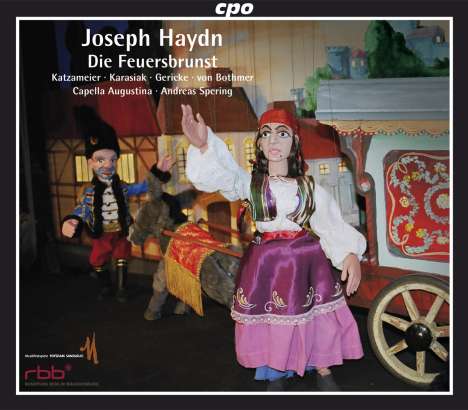

Joseph Haydn: Die Feuersbrunst (oder "Das abgebrannte Haus") auf 2 CDs
Die Feuersbrunst (oder "Das abgebrannte Haus")
Herkömmliche CD, die mit allen CD-Playern und Computerlaufwerken, aber auch mit den meisten SACD- oder Multiplayern abspielbar ist.
Lassen Sie sich über unseren eCourier benachrichtigen, falls das Produkt bestellt werden kann.
(Marionetten-Singspiel H29b: A)
- Künstler:
- Otto Katzameier, Andreas Karasiak, Isa Katharina Gericke, Ferdinand von Bothmer, Capella Augustina, Andreas Spering
- Label:
- CPO
- Aufnahmejahr ca.:
- 2006
- UPC/EAN:
- 0761203721320
- Erscheinungstermin:
- 25.5.2009






Von Hanswurst und Colombine
Marionetten- und Puppentheater mit Musik waren und sind in Österreich immer äußerst beliebt. Noch heute gibt es in Salzburg ein Marionettenoperntheater. Zwischen 1773 und 1779 gab es auch in der Sommerresidenz des Fürsten Nikolaus Esterhazy auf Esterhaza (im heutigen ungarischen Fertöd gelegen) eine Marionettenbühne, und bekanntlich war zu dieser Zeit Joseph Haydn oberster Kapellmeister am Hofe. Also schrieb er auch Opern für das Puppentheater – eine Tatsache, die heute wenig bekannt ist. So entstand um 1776 „Die Feuersbrunst oder das abgebrannte Haus“: Haydn verwendet nicht nur Wiener Dialekt, sondern zeigt uns eine der letzten Hanswurst-Komödien, in der alle Sympathien dem armen Burschen aus dem Volk gelten. In ihrer Volkstümlichkeit und Deftigkeit scheint dieses köstliche Singspiel für die Dienerschaft geschrieben zu sein, für das Stubenmädel, den Kutscher und den kleinen Hofbeamten. Haydn folgt letztlich hier dem gleichen Prinzip der Volkstümlichkeit wie nach ihm Mozart in seiner „Zauberflöte“. Eine wahre Entdeckung zum Haydn-Jahr!
Product Information
Harlequin and Columbine
Dramatic productions with marionettes, puppets, and music have always enjoyed great
popularity in Austria. Between 1773 and 1779 there was a marionette theater at the summer
residence of Prince Nikolaus Esterházy at Esterháza (in today’s Fertöd, Hungary), and at the time,
as is generally known, Joseph Haydn was the principal music director at this court. Although it is
today a little-known fact, Haydn too wrote operas for puppet theater, including Die Feuersbrunst
oder das abgebrannte Haus (The Conflagration or The Burned House) of 1776. In this work
Haydn not only employs Viennese dialect but also presents to us one of the last Hanswurst comedies
in which all the sympathies are for this poor fellow from the folk and German cousin of Harlequin.
The popular character and robust wit of this delightful singspiel suggest that it was written for the
servants, for the domestic maid, the coachman, and the minor court official. Here Haydn adhered to
the same principle of popularity as Mozart later would do in The Magic Flute. A genuine discovery
in honor of the Haydn Year 2009!
Rezensionen
FonoForum 10/09: "Die Capella Augustina unter Andreas Spering spielt auf historischen Instrumenten und gibt bereits in der dreiteiligen Ouvertüre eine zugriffige, sehr lustvolle musikalische Gangart vor. Witz, Schalk und heiterer Ernst geben der Interpretation ein überzeugendes Gepräge." Neue Westfälische 09/09: "Hochklassiges Hörvergnügen." Toccata 05/10: "Eine amüsante und unterhaltsame Aufnahme, mit grossartiger Musik von Haydn." Neue Zürcher Zeitung 09/10: "Eine Freude sind auch die von Dörte Reisener nach einer amerikanischen Vorlage ins Deutsche übertragene Dialoge, die vno Schauspielern in ergötzlichem Wiener Dialekt gesprochen werden."Tracklisting
Disk 1 von 2 (CD)
-
1 Die Feuersbrunst, opera, H. 29b/A (uncertain authenticity): Sinfonia. Allegro
-
2 Die Feuersbrunst, opera, H. 29b/A (uncertain authenticity): Sinfonia. Andante
-
3 Die Feuersbrunst, opera, H. 29b/A (uncertain authenticity): Sinfonia. Finale Presto
-
4 Die Feuersbrunst, opera, H. 29b/A (uncertain authenticity): Act 1. Dialog
-
5 Die Feuersbrunst, opera, H. 29b/A (uncertain authenticity): Act 1. No. 1. Aria
-
6 Die Feuersbrunst, opera, H. 29b/A (uncertain authenticity): Act 1. Dialog
-
7 Die Feuersbrunst, opera, H. 29b/A (uncertain authenticity): Act 1. No. 2. Aria
-
8 Die Feuersbrunst, opera, H. 29b/A (uncertain authenticity): Act 1. Dialog
-
9 Die Feuersbrunst, opera, H. 29b/A (uncertain authenticity): Act 1. No. 3. Rezitativ und Aria
-
10 Die Feuersbrunst, opera, H. 29b/A (uncertain authenticity): Act 1. Dialog
-
11 Die Feuersbrunst, opera, H. 29b/A (uncertain authenticity): Act 1. No. 4. Aria
-
12 Die Feuersbrunst, opera, H. 29b/A (uncertain authenticity): Act 1. Dialog
-
13 Die Feuersbrunst, opera, H. 29b/A (uncertain authenticity): Act 1. No. 5. Aria
-
14 Die Feuersbrunst, opera, H. 29b/A (uncertain authenticity): Act 1. Dialog
-
15 Die Feuersbrunst, opera, H. 29b/A (uncertain authenticity): Act 1. No. 6. Aria
-
16 Die Feuersbrunst, opera, H. 29b/A (uncertain authenticity): Act 1. Dialog
-
17 Die Feuersbrunst, opera, H. 29b/A (uncertain authenticity): Act 1. No. 7. Aria
-
18 Die Feuersbrunst, opera, H. 29b/A (uncertain authenticity): Act 1. Dialog
-
19 Die Feuersbrunst, opera, H. 29b/A (uncertain authenticity): Act 1. No. 9. Aria
-
20 Die Feuersbrunst, opera, H. 29b/A (uncertain authenticity): Act 1. Feuerwerk
-
21 Die Feuersbrunst, opera, H. 29b/A (uncertain authenticity): Act 1. No. 10. Aria
-
22 Die Feuersbrunst, opera, H. 29b/A (uncertain authenticity): Act 1. Feuerwerk
-
23 Die Feuersbrunst, opera, H. 29b/A (uncertain authenticity): Act 1. Dialog / No. 11. Coro
Disk 2 von 2 (CD)
-
1 Die Feuersbrunst, opera, H. 29b/A (uncertain authenticity): Act 2. Dialog
-
2 Die Feuersbrunst, opera, H. 29b/A (uncertain authenticity): Act 2. No. 12. Aria
-
3 Die Feuersbrunst, opera, H. 29b/A (uncertain authenticity): Act 2. Dialog
-
4 Die Feuersbrunst, opera, H. 29b/A (uncertain authenticity): Act 2. No. 14. Duett
-
5 Die Feuersbrunst, opera, H. 29b/A (uncertain authenticity): Act 2. Dialog
-
6 Die Feuersbrunst, opera, H. 29b/A (uncertain authenticity): Act 2. No. 15. Aria
-
7 Die Feuersbrunst, opera, H. 29b/A (uncertain authenticity): Act 2. Dialog
-
8 Die Feuersbrunst, opera, H. 29b/A (uncertain authenticity): Act 2. No. 16. Aria
-
9 Die Feuersbrunst, opera, H. 29b/A (uncertain authenticity): Act 2. Dialog
-
10 Die Feuersbrunst, opera, H. 29b/A (uncertain authenticity): Act 2. No. 17. Duett
-
11 Die Feuersbrunst, opera, H. 29b/A (uncertain authenticity): Act 2. Dialog
-
12 Die Feuersbrunst, opera, H. 29b/A (uncertain authenticity): Act 2. No. 18. Aria
-
13 Die Feuersbrunst, opera, H. 29b/A (uncertain authenticity): Act 2. Dialog
-
14 Die Feuersbrunst, opera, H. 29b/A (uncertain authenticity): Act 2. No. 19. Aria
-
15 Die Feuersbrunst, opera, H. 29b/A (uncertain authenticity): Act 2. Dialog
-
16 Die Feuersbrunst, opera, H. 29b/A (uncertain authenticity): Act 2. Dialog
-
17 Die Feuersbrunst, opera, H. 29b/A (uncertain authenticity): Act 2. No. 21
-
18 Die Feuersbrunst, opera, H. 29b/A (uncertain authenticity): Act 2. Dialog
-
19 Die Feuersbrunst, opera, H. 29b/A (uncertain authenticity): Act 2. No. 22. Aria
-
20 Die Feuersbrunst, opera, H. 29b/A (uncertain authenticity): Act 2. Dialog
-
21 Die Feuersbrunst, opera, H. 29b/A (uncertain authenticity): Act 2. No. 23. Aria
-
22 Die Feuersbrunst, opera, H. 29b/A (uncertain authenticity): Act 2. No. 24. Aria
-
23 Die Feuersbrunst, opera, H. 29b/A (uncertain authenticity): Act 2. Dialog
-
24 Die Feuersbrunst, opera, H. 29b/A (uncertain authenticity): Act 2. No. 25. Duett
-
25 Die Feuersbrunst, opera, H. 29b/A (uncertain authenticity): Act 2. Dialog
-
26 Die Feuersbrunst, opera, H. 29b/A (uncertain authenticity): Act 2. No. 27. Coro
Mehr von Joseph Haydn
-
Joseph HaydnSämtliche Klaviertrios(6)9 CDsAktueller Preis: EUR 29,99
-
Joseph HaydnL'Incontro Improvviso H18:6 (Dramma giocoso per musica)(8)2 CDsVorheriger Preis EUR 29,99, reduziert um 0%Aktueller Preis: EUR 14,99
-
Joseph HaydnSämtliche Klavierkonzerte (H18 Nr.1-6,8,10,11)(12)2 CDsVorheriger Preis EUR 24,99, reduziert um 0%Aktueller Preis: EUR 14,99
-
Andreas RombergSymphonie Nr.4 op.51 "Alla Turca"(5)CDVorheriger Preis EUR 17,99, reduziert um 0%Aktueller Preis: EUR 7,99